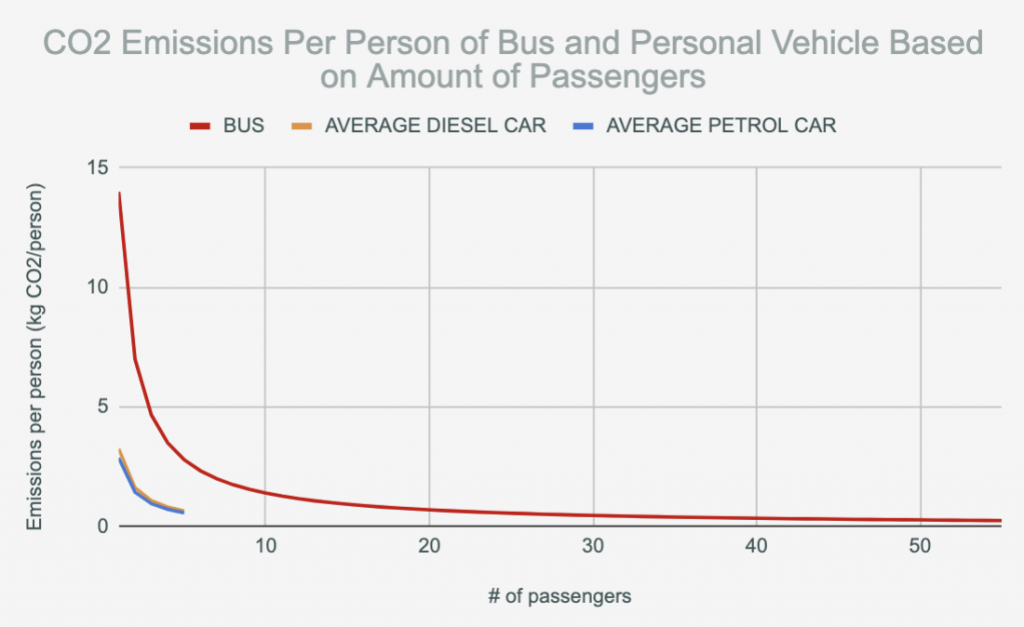
The figure above shows a comparison of the emissions per person for a trip that is 20 km long. Changing the distance scales the values on the y-axis, but the percentage difference in emissions between the three categories will not change.
Methodology
Bus Emissions
Bus emissions are estimated using a single user input: the distance the user is travelling. We assume all buses use Diesel fuel (2-D), and using the density of diesel 2-D, trip distance, and average kmpl for a Volvo bus (common in Cyprus), the calculator estimates the amount of fuel needed for the trip. The mass of fuel is multiplied by an emissions factor (ratio of CO2 emitted to mass of fuel consumed) to determine the total amount of CO2 emitted. Once this number is calculated, the next question is how many passengers are on the bus. This can be used to calculate the average emissions per person. The emissions-per-person statistic is particularly meaningful when comparing the emissions between taking a bus for the trip or a personal car.
For validation, our estimates were compared with emission values for buses within the 27 EU countries. The reported data was in units of kg of CO2 per passenger per kilometre, so using our estimate for total bus emissions (can be found by assuming 1 passenger), we divided by the distance travelled and average number of passengers on a bus in London (9.2, not accurate for Cyprus but useful for comparing). This yielded an emissions per passenger per kilometre within 5% of the EU average.
Sources:
Density of diesel bus fuel
https://www.engineeringtoolbox.com/fuels-densities-specific-volumes-d_166.html
Used to convert litres of fuel needed to kg of fuel needed.
Volvo bus information (kmpl)
The site states that Volvo buses average 26 litres of fuel per 100 km driven. By dividing these numbers, the approximate value of 3.85 kmpl emerges.
EEA PDF detailing bulk emissions factors for multiple fuel types in various European countries:
Page 127 shows Cyprus specific data from 2005.
Diesel light duty vehicles and diesel heavy duty vehicles have the same emissions factor, and this is the value used for the bus, in units of kg CO2/kg fuel.
German Bus Data Validation
Methodology for GHG Efficiency of Transport Modes | CE Delft
Page 21. EU-27, total bus emissions. 80 g CO2/passenger-km. Average bus in the UK has 9.2 passengers. Compared by taking our total calculated emissions, dividing by the distance and 9.2, and getting 76 g CO2/passenger-km.
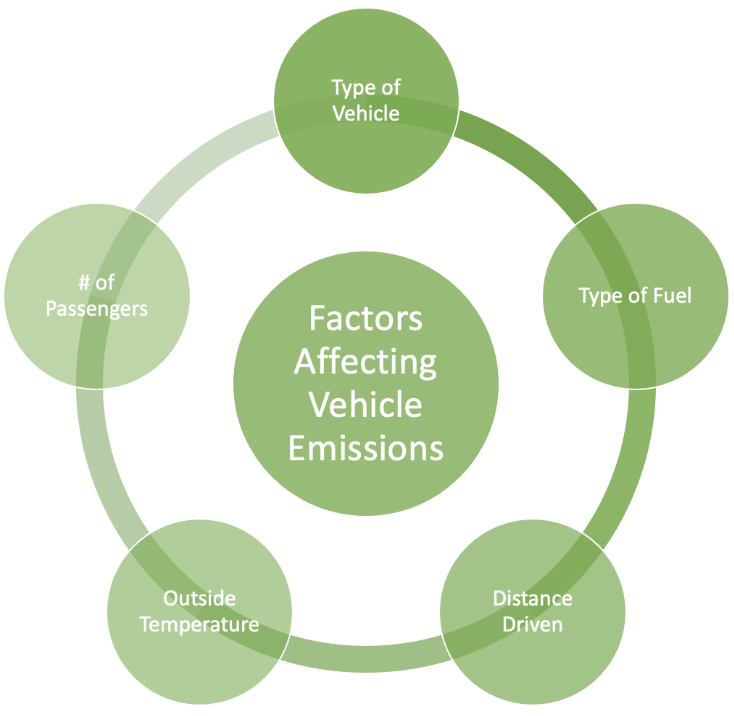
Power Point was used to make the graphic demonstrating factors affecting vehicle emissions.
Personal Vehicle Emissions
Personal vehicle emissions are calculated using only two user inputs. The first is the distance the user is travelling, and the second is the type of fuel that their car takes. Cyprus national average emissions factors are available for both diesel and petrol cars, which when multiplied by distance driven, provide an estimate for total emissions for the trip. This can then be divided by the number of passengers to find emissions per person and compared with bus data.
Because the data is taken from Cyprus national averages based on fuel type, it is difficult to validate our estimates as they come from the most correct data available. If you want to compare the emissions per kilometre for your own car (if the model is in the database), you can do so by using this Cyprus government website: Personal Vehicle Emissions Database
Sources:
EEA charts showing average CO2 emissions per kilometre in Cyprus based on car fuel type
Go to Dashboard (up top), then filter for Cyprus and then diesel and petrol each separately. Chart on the right will show the average amount of CO2 emitted per km driven using that fuel type. If only fuel type is entered into the calculator, these are used as the default emission factors.
Cyprus governmental database of car CO2 emissions
Personal Vehicle Emissions Database
By plugging in your car model and year, many other fields yield the engine displacement and transmission automatically. By choosing options from a drop down menu for every field, a number will display with your car’s emissions per kilometre.